How to Specify Environmental and IP Requirements for a Slip Ring
Specify slip ring environmental requirements beyond an IP rating: temperature, water, dust, corrosion, vibration and the installation conditions to verify.
2026-09-19 13:57 by admin
- Share
-

-

-

-

-

Define slip ring environmental requirements by describing what reaches the assembly in its installed position: heat, moisture, dust, cleaning fluids, corrosion exposure and mechanical disturbance. Then agree the protection and verification needed for those conditions. An IP rating is one part of that decision, not a complete statement of environmental suitability.
For OEM equipment, the useful question is not simply “Is this a waterproof slip ring?” It is whether the proposed configuration and its installed interfaces address the exposure the machine will actually experience during operation, cleaning, storage and maintenance.
Describe exposure at the slip ring location
Start with the local installation environment rather than a broad label such as indoor, outdoor or marine. Record which parts are exposed, which are sheltered and how conditions change between operating modes. The environment around the machine and the environment inside a protective housing can differ, so identify the boundary being specified.
A machine enclosure may reduce direct exposure while introducing a different local temperature or moisture condition. State whether the slip ring is inside that enclosure, beside a heat source or exposed when a service panel opens. Do not assume the enclosure eliminates all environmental requirements.
| Exposure | Useful input from the OEM | Selection question |
|---|---|---|
| Temperature | Local operating range, hot or cold startup and storage conditions | Which conditions require operation rather than survival only? |
| Water | Rain, splashing, cleaning jets or immersion scenario | What exposure must the installed assembly withstand? |
| Dust | Material, concentration, deposition and cleaning practice | Where can contamination reach moving or electrical interfaces? |
| Corrosion and chemicals | Salt exposure, named fluids and contact conditions | What compatibility or corrosion evidence is needed? |
| Vibration and shock | Source, operating mode, mounting location and available measured profile | What disturbance reaches the installed slip ring? |
| Humidity and condensation | Moisture conditions and temperature transitions | Can moisture form inside the protected space? |
Use measured installation data where available. If a condition is estimated, identify the estimate and its owner instead of treating it as a confirmed equipment requirement.
Use the IP rating for the question it answers
A slip ring IP rating describes specified enclosure protection against ingress; it does not establish complete suitability for every outdoor or industrial environment. Match the required protection to the actual exposure and the assembly boundary being assessed. Temperature, corrosion, chemicals and mechanical disturbance need their own requirements rather than an assumed answer from the IP code.
The first IP digit addresses protection against solid objects and the second addresses water ingress. Analog Devices' technical explanation of IP ratings also explains that IEC 60529 does not cover corrosion resistance or the effects of icing and coolants.
That distinction prevents a common specification error: treating a protection label as proof of chemical compatibility or coastal durability. Define those needs separately.
Ask what enclosure, cable exits, connectors and installation conditions the claimed rating covers. For a rotary assembly, also ask whether the relevant verification represents the required stationary or rotating condition. Do not infer this from the number alone.
Avoid requesting the highest available number without describing the exposure. A useful inquiry gives the supplier enough context to assess the required protection rather than merely repeat a label.
Separate temperature, humidity and water conditions
List temperature, humidity and direct water exposure separately, then explain when they occur together. Distinguish operating conditions from storage and transportation, and identify startup after a hot, cold or damp period. A single ambient temperature range does not describe every condition the slip ring encounters inside the completed machine.
For temperature, specify the location to which the measurement or estimate applies. An outdoor weather value is not necessarily the local temperature beside a drive or inside a housing. Include relevant operating modes rather than selecting unrelated extremes and assuming they occur simultaneously.
For moisture, distinguish humid air from condensation and from externally applied water. During cleaning, describe the actual fluid, direction of exposure and machine state. For an immersion requirement, identify the intended conditions for supplier review instead of relying on the word “waterproof.”
Define the protected assembly
Clarify responsibility for customer-supplied housings, cable entries and connectors. The environmental question concerns the installed arrangement, including interfaces that may be outside the slip ring supplier's scope. Ask how those interfaces affect the proposed protection boundary before design approval.
Treat corrosion, vibration and shock as separate requirements
Specify corrosion, vibration and shock through the exposure or test requirement that matters to the machine, rather than grouping them under “harsh environment.” Identify the relevant location, operating mode and required evidence. A supplier can then distinguish a material or configuration discussion from a qualification requirement that needs an agreed method and acceptance criteria.
For salt spray or other corrosion evaluation, state the customer requirement and the required basis for assessment. Do not equate a test duration with a guaranteed number of service years. If the project has no defined corrosion criterion, identify that gap before accepting a generic durability statement.
For chemical exposure, name the fluid rather than writing “oil resistant” or “chemical resistant” without context. Record how contact occurs and whether cleaning or maintenance changes that exposure.
For vibration and shock, share an applicable measured profile or customer specification when available. A broad adjective such as “high vibration” cannot define the verification conditions. This article does not supply universal acceleration limits or a default test severity; those must come from the application and the agreed evaluation.
Match the requirement to a documented configuration
Compare the environmental requirement with the proposed configuration and record what is standard, optional or still subject to engineering review. A catalog's available options are useful starting points, but they do not prove that every option can be combined or that a particular installed assembly already meets the complete exposure specification.
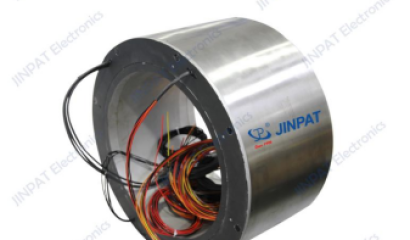
JINPAT's through-bore selection document separates temperature, humidity and protection grade. Its customization notes also identify special-environment and waterproof or underwater options. These are documented directions for discussion, not a blanket claim that every through-bore slip ring is suitable for those conditions.
| Review outcome | Appropriate next action |
|---|---|
| Documented configuration matches the defined exposure | Confirm the current configuration and supporting conditions |
| An optional protection arrangement is proposed | Identify the option explicitly and confirm the interfaces it covers |
| Exposure exceeds or differs from the available evidence | Request an application review and define the verification gap |
| The environment is still described only in general terms | Collect the missing installation information before selection |
Keep exact ratings and capability claims tied to the current proposal. Do not combine a temperature statement from one configuration with a water-protection statement from another.
Send a focused environmental brief with the RFQ
Submit an environmental brief that identifies exposure, operating mode, installation boundary and required evidence. Mark unresolved conditions and separate mandatory requirements from preferences. This gives the supplier a defined basis for assessing the proposed configuration and makes environmental exceptions visible before they become assumptions in the quotation or design approval.
Before sending it, check that “outdoor,” “waterproof” or “heavy duty” has not replaced a description of actual conditions. Check that storage and operation are distinguished, and that any customer-specified verification requirement includes its reference and acceptance basis.
Ask JINPAT to review the environmental brief against the proposed slip ring configuration, including any optional protection arrangement. Then use the OEM slip ring specification checklist to coordinate the remaining requirements. The environmental attachment should stay focused on exposure and verification boundaries, while the main RFQ links it to the machine's other specifications.